Secrets Of Mosfet Cross Reference and Replacement Guide
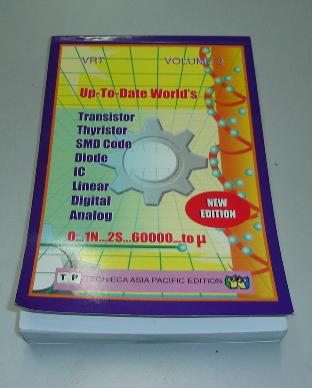
A Semiconductor Replacement Guide Searching for the right mosfet cross reference or datasheet, one has to look for a semiconductor transistor replacement data book and not the Philip ECG master replacement guide. Almost all the transistor replacement book will published out the specification of a particular components such as type of component it belong whether it is a fet, scr, bipolar transistor, horizontal output transistor and also the voltage, ampere, wattage, ohm, frequency and suggested substitution part number.
From my experienced, the substitution part number that was recommended by the data book is not always 100 % match. If you have the time, I would like to suggest to you that, find the right part number by yourself rather than depending on the transistor data book.
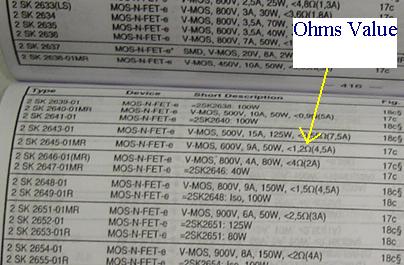
It is the same when you look for horizontal output transistor (HOT) specification which doesn't mean that the bigger specification, the better the substitution part number is. In searching for Mosfet cross reference, you have to look at the ohms value which is provided by the transistor data book besides the specification of voltage, ampere and the wattage. The replacement, besides the same or higher in voltage, ampere and wattage, one should also consider the ohms value. The ohms value has to be as close as possible.
Arrow is showing the mosfet ohms value in a transistor substituion book
If the original fet part number is 1 ohm then a good replacement mosfet must have the ohm values between of 0.5 to 1.5 ohm. Do not substitute it with a too high or too low ohms value as this will make the mosfet run warmer and eventually blow the mosfet itself. Even though you can get a replacement with a higher voltage, ampere and wattage, if the ohms value is too low or too high, the mosfet will still burnt after on for quite a while.
It runs well for sometimes before it breakdown again. After two weeks the customer brought back the printer with the same complaint which is no power. Upon checking the power side I found the same mosfet gave up again. Substituting with another mosfet part number that have a similar specification especially the ohms value solved the printer no power symptom.
Specification with larger voltage, ampere and wattage don’t guarantee that the replacement mosfet will work. So, taking the mosfet ohms value into consideration, you will have a higher chances to repaired the equipment and sometimes the replacement mosfet will also last longer.
|
|
Contacts Sync Pro 8.2.1 Apr 2026
What distinguishes the 8.2.1 update from its predecessors is the refinement of its conflict-resolution engine. Data synchronization is inherently risky; overlapping updates can lead to duplicate entries or, worse, data loss. Contacts Sync Pro 8.2.1 introduces a more granular "smart merge" logic that analyzes timestamps and metadata fields to determine the most current "source of truth." This minimizes manual intervention, allowing the user to trust the automation rather than policing it. Security and Privacy as a Priority
The brilliance of a tool like Contacts Sync Pro 8.2.1 lies in its invisibility. It is a "quiet" utility; when it functions perfectly, the user forgets it exists. By automating the tedious task of manual entry and cross-referencing, it reclaims valuable time for the user. In a professional context, this accuracy is vital—having the correct phone number or email address at the exact moment of a critical outreach can be the difference between a successful deal and a missed opportunity. Conclusion Contacts Sync Pro 8.2.1
The evolution of Contacts Sync Pro to version 8.2.1 represents a significant milestone in the ongoing quest for seamless data management across platforms. At its core, this software addresses a fundamental challenge of the digital age: the fragmentation of personal and professional connections across disparate ecosystems. The Problem of Digital Fragmentation What distinguishes the 8
As data privacy regulations like GDPR and CCPA become the standard, the handling of contact information—which often includes sensitive phone numbers, physical addresses, and birthdays—requires heightened security. Version 8.2.1 emphasizes end-to-end encryption during the sync process. Unlike some cloud-based intermediaries that may index user data for metadata analysis, Contacts Sync Pro focuses on a "pass-through" model, ensuring that the user remains the sole owner of their information. Productivity and the "Quiet" Utility Security and Privacy as a Priority The brilliance
Contacts Sync Pro 8.2.1 is more than just a software update; it is a response to the increasing complexity of our digital lives. By prioritizing reliability, security, and cross-platform harmony, it allows users to transcend the limitations of hardware ecosystems. It serves as a reminder that in our hyper-connected world, the tools that manage our connections are just as important as the connections themselves.
In a world where users are no longer tethered to a single operating system, the "walled garden" approach of major tech giants has often resulted in siloed contact lists. A professional might use Outlook for work, iCloud for personal use, and Gmail for side projects. Version 8.2.1 of Contacts Sync Pro acts as a sophisticated bridge, employing advanced bidirectional synchronization algorithms to ensure that a change made in one environment is instantly and accurately reflected in all others. Architectural Precision in 8.2.1
Copyright@ 2006-2014-www.ElectronicRepairGuide.com All Rights Reserved